Five Reasons for Story Priming
Jul 17, 2026
Exploiting the zone of maximum curiosity to engage your students for a story
Audio first
The following is a 17-second audio consisting of a scream followed by laughter.
After listening to the audio, there are some fundamental questions to ask:
- What's going on here?
- Who is involved?
- Where are they and what are they doing?
- What causes the scream and laughter?
At this point, it's impossible to turn off your imagination. You may have speculated about answers or created mental images to accompany what you heard.
Although you probably don't have a fully-developed narrative, that doesn't matter – you are now primed for the story.
Story priming
Story priming is a general term I use to describe any technique for preparing students for a story they are about to hear.
The above isolated audio is the first step of the Videotelling framework which looks like this:
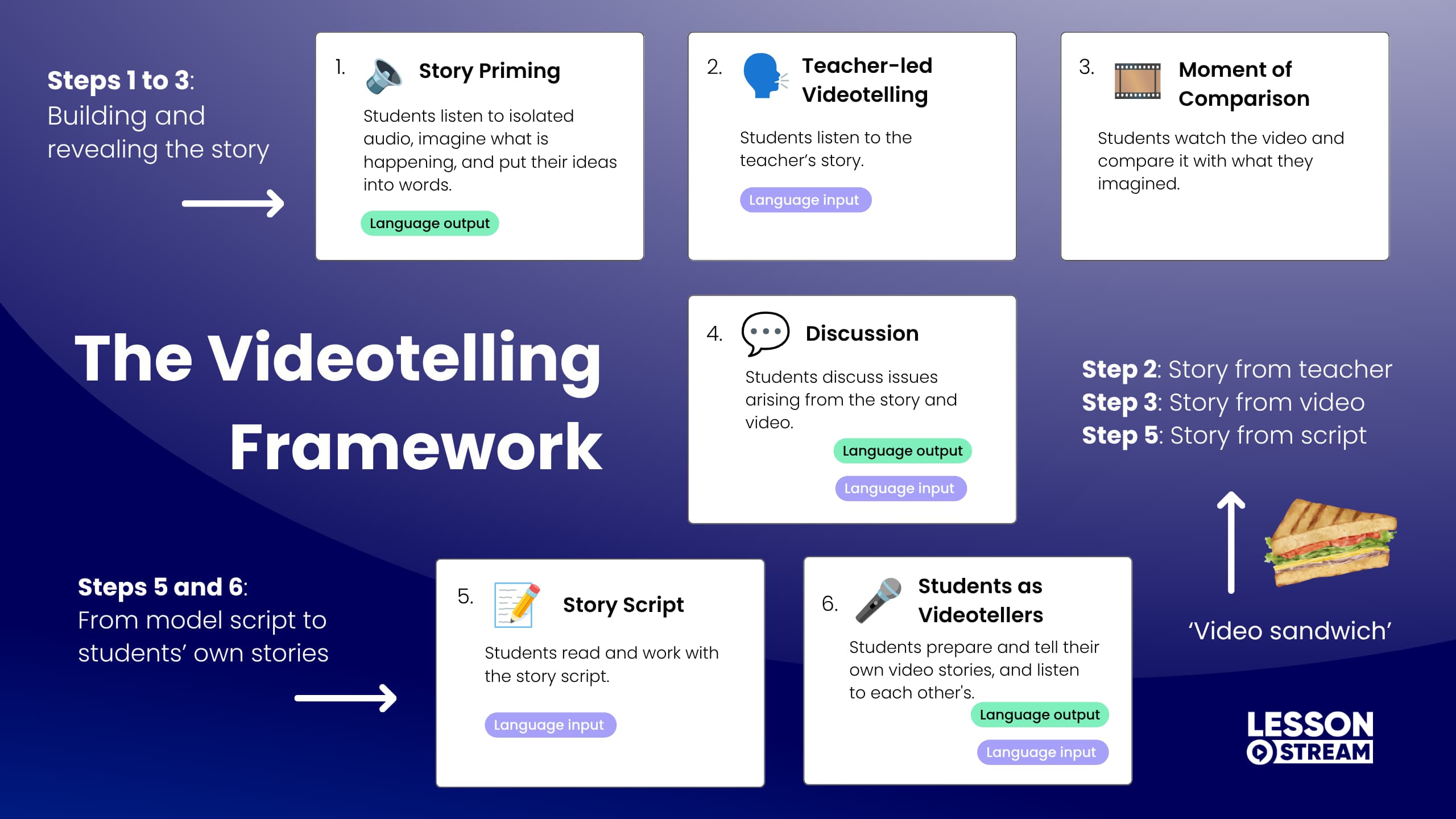
(Note: To find out more and also see the full video, you can sign up for my mini course at the bottom of this post)
In this post, I would like to suggest five reasons for using story priming techniques like this one.
1. Curiosity
Hearing a scream followed by laughter is naturally very curiosifying (invented word!). Students will want to know what's coming next. Now you have their attention – they are engaged.
2. Comprehension
After listening to the audio, students intuitively know the video involves an incident which causes shock followed by relief. This means they know the basic shape of the story.
The next step of the framework is for the teacher to tell the story (Teacher-led Videotelling – see above). As they listen, they can map the teacher's words onto this basic outline and make sense of the story. This is a great way to support their listening comprehension.
3. Language output
Perhaps the most obvious reason for using an audio like this is to get students putting their creative ideas into words. Here is what course participant Claire had to say:
I think it’s a mother and daughter. They’re walking down a gravel path when the daughter spots a snake and screams. Her mother shows her it’s fake, and they start laughing.
4. Language input
In this case, the isolated audio has no spoken words. So, although students have to listen, they are not listening for language.
But isolated audio is just one type of story priming technique. Another approach is to give students a list of items and ask them to predict what happens in the story:
🪂 A clumsy skydiver
🤔 A mystery object
🐷 A curious pig
👀 46 million views
This story priming technique has the advantage of introducing key language – words and phrases students will need when they make their predictions.
Note: These items come from Pogo and the Mystery Object – a story which is visually referenced on the cover of my book Videotelling: YouTube Stories for the Classroom.
5. A natural way in for the storyteller
Most teachers will share stories with their students from time to time. Often, these will be unplanned and spontaneous with some sort of natural way in – a whole-class conversation, for example.
But what about planning to incorporate a story into a lesson in a structured way? In this case, there is always a question to consider: How do I begin the story? How do I find that way in?
Of course, you could start by saying: 'I want to tell you a story.'
But doing this will put you on the spot and add unnecessary pressure.
On the other hand, story priming means that students will already be curious and invested when you get to that point. They will genuinely want to hear the story. Story priming creates that way in and reduces the pressure.
In my new book (coming in 2027) I list twelve different story priming techniques, all of which allow the teacher to transition naturally and seamlessly to the storytelling – in the least stressful way possible.
🎞️ Video & Story
In this mini‑course, you'll take part in a complete, ready‑to‑teach video lesson built around the 6‑step Videotelling framework. You'll experience it as your students would, then take away the insights you need as a teacher to apply the framework to other videos you'd like to use in your teaching.
The course takes less than 60 minutes to work through.
Thanks for reading!
Jamie
Sign up to the LessonStream Post and get fresh ideas for teaching with video, image and story – straight to your inbox. I'll also send you my ebook – Seven Ways to Curiosify Your Students