Welcome to the LessonStream Post – fresh ideas for teaching with image, video and story. Sign up here to never miss an issue.
In this post, I share an idea central to visual literacy.
August 1945
Eighty years ago this month, crowds filled New York’s Times Square to celebrate the end of the Second World War for the United States.
Amid the celebrations, a sailor grabbed and kissed a woman in a white uniform – apparently a nurse. The moment became one of the most famous images of the 20th century.
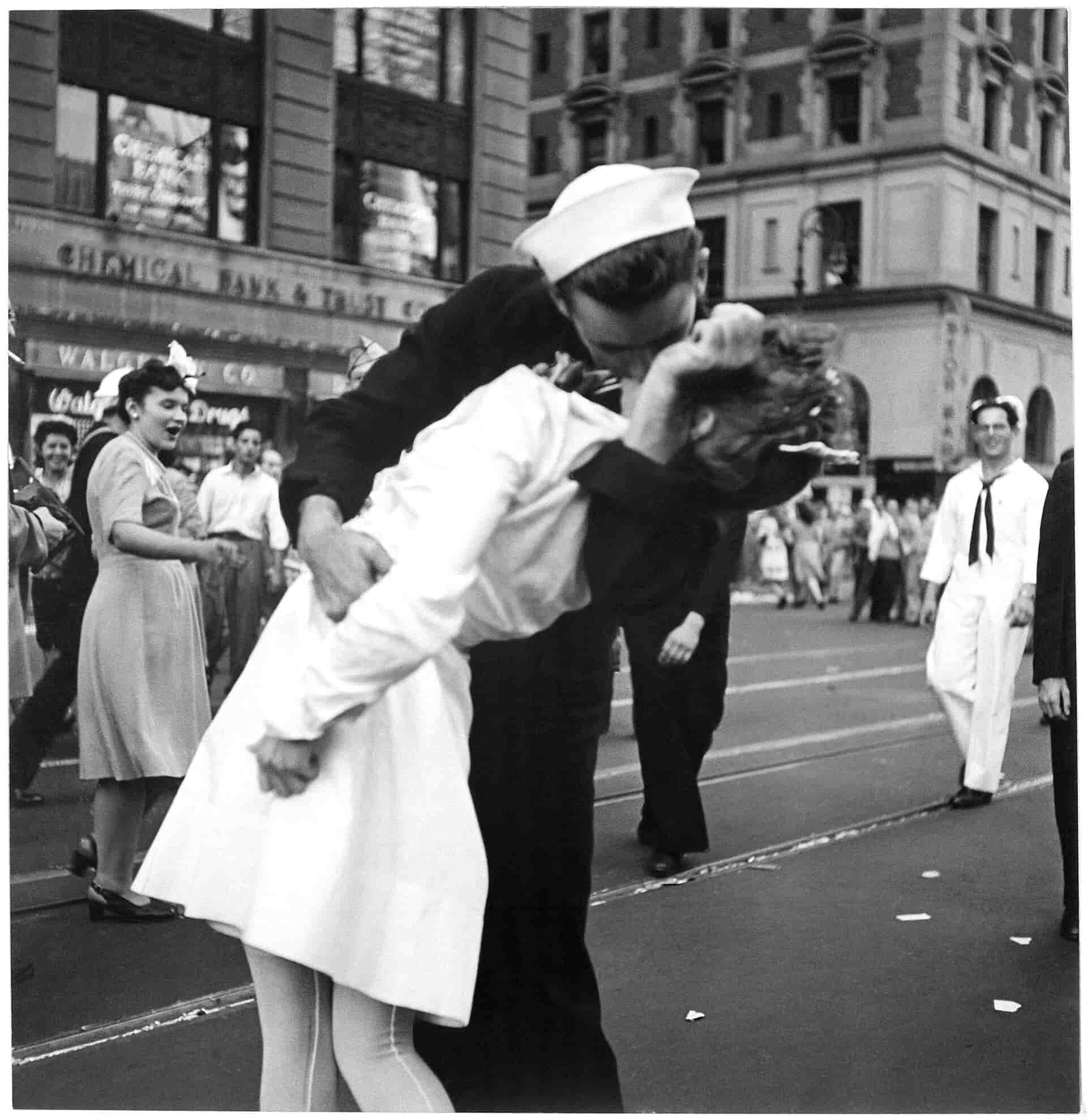
The same moment was captured by two different photojournalists:
1. Alfred Eisenstaedt
The most famous version, V-J Day in Times Square, was taken by German-born photojournalist Alfred Eisenstaedt. It began its rise to iconic status after being published in Life magazine on 27 August 1945. You can see it here.
2. Victor Jorgensen
A different version of the kiss was captured by US Navy photojournalist Victor Jorgensen. His photograph, Kissing the War Goodbye (above), appeared in The New York Times. Because Jorgensen was serving as an on-duty federal government employee, the image is in the public domain and can be reproduced here without copyright concerns.
A challenged interpretation
Despite its familiarity throughout my life, I don't recall ever analysing it – even on a superficial level. For me, it was always just a passive interpretation: a sailor and his sweetheart being reunited after the war.
And then one day in my early twenties, that interpretation was challenged by an episode of The Simpsons.
The episode was titled Bart the General. After Bart rallies the neighbourhood kids to win a playground war against the school bully Nelson, the victors celebrate in the street.
In the scene which resembles the famous image, a boy in a sailor’s hat grabs, dips and kisses Lisa. She immediately pulls away and slaps him.
|

The photographer's account
I have no idea if The Simpsons creator Matt Groening was aware of the story behind the image. But the cartoon kiss appears to parallel the photographer's own description of how the picture came to be.
A 1969 publication titled The Eye of Eisenstaedt included the following account:
I was walking through the crowds on V-J Day, looking for pictures. I noticed a sailor coming my way. He was grabbing every female he could find and kissing them all – young girls and old ladies alike. Then I noticed the nurse, standing in that enormous crowd. I focused on her, and just as I'd hoped, the sailor came along, grabbed the nurse, and bent down to kiss her.
In recent years, the image has been re-examined, with some arguing that one of the most celebrated photographs of the 20th century may in fact depict an act of sexual assault.
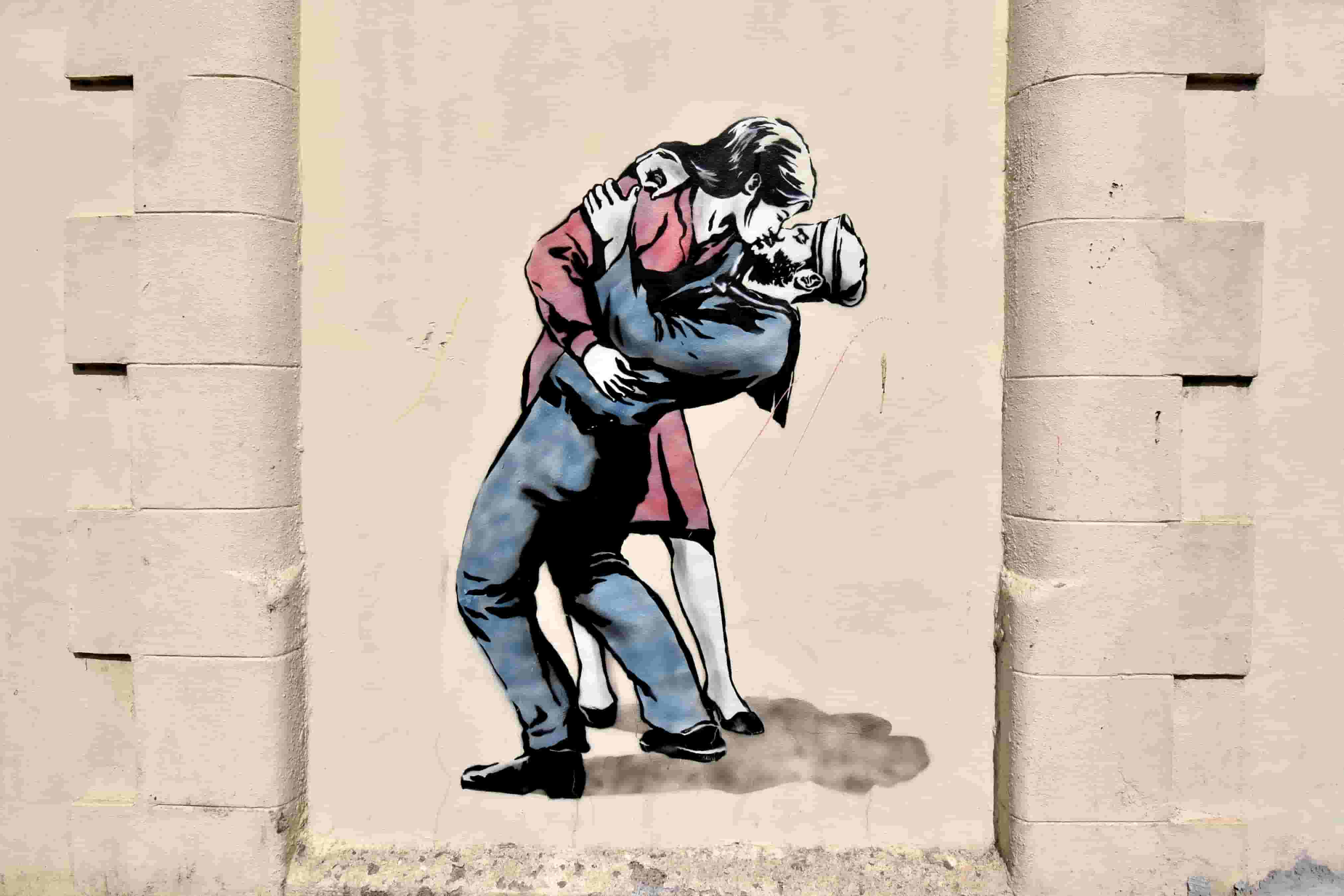
This piece of street art depicts a role reversal of the famous kiss – without the headlock (Image shared with Creative Commons licence by user Daniel Naczk)
Every picture tells a story?
They say that every picture tells a story. But it’s not as simple as that.
Pictures don’t tell stories – human beings do. In response to an image, each of us will construct our own narrative and often, the details will be different.
There is never just one story. An iconic image like V-J Day in Times Square sits at the centre of a complex and ever-shifting web of narratives – each shaped by the perspectives and experiences of those who engage with it.
Understanding this is central to developing visual literacy.
Lesson plan
The diversity of interpretations means that images like this provide an excellent starting point for discussion in the language classroom. My latest lesson plan – Times Square Kiss – provides a framework for students to compare, question and research their own interpretations of this iconic photograph and others like it.